






Environment and climate
What is an EPD? How do you reduce the carbon footprint of your product? And how can aluminium become more sustainable? Find the answers on this page.

After the bauxite has been mined, a lot of energy is required to produce aluminium. If the electric energy comes from coal firing, the production of 1 kg aluminium can cause as much as 20 kgs of carbon dioxide emissions.
However, if the energy for the production of aluminium comes from renewable sources, the carbon footprint is as low as 4 kg pr. kg aluminium with the newest technologies.
In Europe, there is already a requirement for a certain percentage of renewable energy. But in other parts of the world, the production of aluminium is often based on coal.
This means that aluminium produced outside of the EU often has a greater carbon footprint that aluminium produced in the EU.
Wie wird der CO₂-Fußabdruck von Aluminium gemessen?
Der CO₂-Fußabdruck eines Produkts wird als Treibhauspotenzial (GWP) definiert, das in CO₂-Äquivalenten (CO₂e) gemessen wird.
How can we reduce the carbon footprint of aluminium?
Grundsätzlich gibt es drei Möglichkeiten, den CO₂-Fußabdruck von Aluminium zu verringern:
- Einsatz erneuerbarer Energien bei der Aluminiumherstellung
- Recycling von Aluminium, um den energieintensiven Elektrolyseprozess zu vermeiden
- Reduzierung des Materialverbrauchs durch gewichtsoptimiertes Design
Was sind Scope 1, 2 und 3?
Scope 1 umfasst die direkten Emissionen des Unternehmens. Dabei handelt es sich um Emissionen, die direkt aus den Gebäuden, Prozessen und Fahrzeugen stammen, die sich im Besitz des Unternehmens befinden.
Scope 2 umfasst die indirekten Emissionen aus der vom Unternehmen bezogenen Energie. Die Emissionen sind indirekt, da sie nicht in den eigenen Einrichtungen des Unternehmens entstehen, aber dennoch eine Folge der Handlungen des Unternehmens sind.
Scope 3 umfasst alle anderen indirekten Emissionen in der Lieferkette, die durch die Aktivitäten des Unternehmens verursacht werden. Dies sind z. B. Emissionen von Lieferanten, Kunden und Transporten.
Die Unterscheidung zwischen diesen drei Scopes stammt aus dem Greenhouse Gas (GHG) Protocol, dem globalen Standard zur Messung und Begrenzung von Emissionen von Unternehmen.
How to reduce your carbon footprint
If you consider the carbon footprint already in the purchasing phase, you can significantly reduce the carbon footprint of your product.
With aluminium, one way to reduce the carbon footprint is to decrease the amount of material. If your default purchase is 1 mm goods, you may be able to get the same quality with 0.9 mm. This saves 10% - on both the price and the carbon footprint.
If you purchase custom aluminium profiles, we can help you optimise your design for reduced material use.
You can also choose to purchase carbon reduced material. We carry GreenAl and RecycAl, which are based on renewable energy and scrap respectively. The quality is exactly the same as regular aluminium – the carbon footprint is the only difference.
GreenAl

The most energy intensive part of aluminium production is the electrolysis process where raw bauxite is transformed into aluminium.
With GreenAl, this process is powered by renewable energy such as hydro or wind power instead of coal or natural gas. This is a far more sustainable process, and the carbon footprint is significantly lower.
For GreenAl, the footprint is 4 kg CO2/kg aluminium.
RecycAl
When aluminium has already been produced, recycling requires very little energy – around 5% of the original energy need.
This is why high scrap content is proportional to a low carbon footprint. For RecycAl, the footprint is as low as 2.04 kg CO2/kg aluminium.
The ability to recycle aluminium endlessly without compromising the quality is one of the advantages of this metal. However, aluminium is a relatively new metal. It was discovered only 200 years ago. This means that most of the aluminium ever produced is still in use – it has not become scrap yet.
Both GreenAl and RecycAl are umbrella terms that cover a range of products from a range of suppliers who all live up to the standards listed here. We can help you find the right product for your needs from our selection of suppliers and products.
Recycling of aluminium
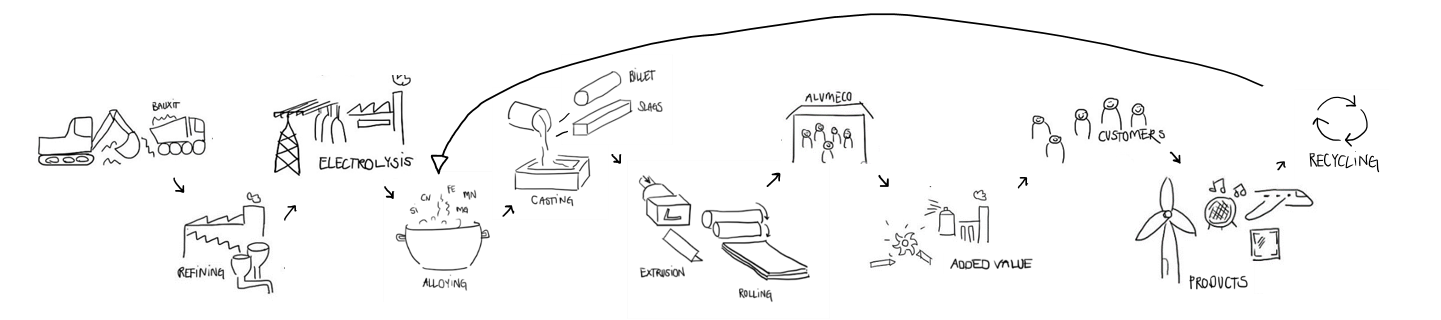
Aluminium can be recycled endlessly without compromising its main properties. As a bonus, recycling requires 95% less energy than mining new aluminium (primary production). This makes it both environmentally friendly and cost effective to recycle as much aluminium as possible.
Scrap: pre-consumer and post-consumer
When speaking of scrap and recycling, it is important to distinguish between pre-consumer scrap and post-consumer scrap. Pre-consumer scrap is material that is turned into scrap before it ever reaches the consumer. An example of this is excess material from the production of cans.
In contrast, post-consumer scrap comes from the consumer, and the material has served its purpose with the consumer. An example of this is a can that is returned through a deposit return scheme.

In Alcobra we produce pre-consumer scrap when we cut aluminium plates and sheets to customised dimensions. To minimise this issue, we have introduced a machine learning software on our saws and developed a policy for the reuse of scrap material. This saves 40 tons of material each year, equivalent to 5% of our annual consumption.
Was ist der Unterschied zwischen Vorverbrauchsabfällen und Nachverbrauchsabfällen?
Vorverbrauchsabfälle entstehen bei der Herstellung eines Produkts, bevor dieses den Endverbraucher erreicht.
Nachverbrauchsabfälle stammen vom Endverbraucher, also vom Verbraucher.
Aus klimatischer Sicht sollte insbesondere die erste Art begrenzt werden. Dabei handelt es sich um Material, das seinen vorgesehenen Zweck nie erfüllt hat und „verschwendet“ wurde. Wir sollten jedoch auch die riesigen Mengen an Nachverbrauchsabfälle weltweit begrenzen, um sicherzustellen, dass möglichst viele unserer Ressourcen Teil von Kreislaufsystemen sind.
Documentation: EPD, LCA, cradle-to-cradle
When you begin your sustainability journey, you will quickly run into the term EPD. This is short for Environmental Product Declaration. An EPD documents the carbon footprint of a product, but also the environmental footprint from other sources than carbon, e.g. waste water.
The EPD is based on a Life Cycle Analysis (LCA). This means that the information in the EPD is the same as in the LCA, and you do not need and EPD if you have an LCA for the specific material or product.
When you set out to map the climate and environmental impact of a product, you need to determine the start and end point of the product's life.
This is often defined as cradle-to-gate or cradle-to-cradle. The latter is more comprehensive than the former.

The life of a product can be divided into five stages:
- Mining of raw materials (cradle)
- Production and manufacturing (gate)
- Transportation
- Consumption
- Disposal (grave)
Cradle-to-gate is a linear view of the product from raw materials to finished product. Cradle-to-cradle is – as the name suggests – a circular view of the product from raw materials to production and consumption and back to recycling of raw materials. In this case, one product’s phase 5 will be another product’s phase 1.
It is common for companies to start with cradle-to-gate at the beginning of their sustainability journey, because that is the part of the cycle that the company can control.
A third option is cradle-to-grave, which is rarely used. This is a highly linear view of the product from raw materials to disposal with no recycling of materials.
Was ist eine EPD?
EPD ist die Abkürzung für „Environmental Product Declaration“ (Umweltproduktdeklaration). Eine EPD basiert auf einer internationalen Norm zur Berichterstattung über die ökologischen und sozialen Auswirkungen der Herstellung eines Produkts.
Eine EPD basiert auf einer Ökobilanz (LCA) und gibt unter anderem den CO₂-Fußabdruck des Produkts an.
Wozu dient eine EPD?
Eine EPD bietet einen Überblick über die ökologischen und sozialen Auswirkungen eines Produkts. Sie enthält auch den CO₂-Fußabdruck des Produkts, doch zur Berechnung des CO₂-Fußabdrucks ist eine EPD nicht unbedingt erforderlich.
Was ist eine Ökobilanz?
LCA ist die Abkürzung für „Life Cycle Analysis“ (Ökobilanz) und bezeichnet eine Untersuchung der Umweltauswirkungen und des Ressourcenverbrauchs über die gesamte Lebensdauer eines Produkts. Dies liefert einen klaren und vergleichbaren Überblick über die tatsächlichen Umweltauswirkungen verschiedener Produkte.
Die Ökobilanz ist in den Normen ISO 14040 und ISO 14044 definiert
Was ist Cradle-to-Cradle?
Cradle-to-Cradle ist die Messung des CO₂-Fußabdrucks vom Rohstoff bis zum Rohstoff. Das bedeutet, dass Cradle-to-Cradle den gesamten Lebenszyklus eines Produkts abdeckt – vom Rohstoff über die Herstellung und den Transport bis hin zur Nutzung und zum Recycling als neue Rohstoffe.
Was versteht man unter „Cradle-to-Gate“?
„Cradle-to-Gate“ ist eine Methode zur Berechnung des CO₂-Fußabdrucks eines Produkts, die die Rohstoffe, die Herstellung und den Transport berücksichtigt. Das bedeutet, dass die Nutzung und Entsorgung des Produkts nicht in die Berechnung einfließen.